Livres en projet et en préparation / Book projects
Hidden in Plain Sight.
Race, Oil Infrastructure and Environmental Sacrifice in the Age of Petrocapitalism
In recent years, California has often been depicted as one of the frontrunner territories paving the way for the gradual phasing-out of oil infrastructure and fossil fuel dependency. Hidden in Plain Sight tells a more contrasted story. The book uncovers the making of indifference and the denial of petrotoxicity, both within and on the outskirts of an overtly socially marginalized and majority-minority communities in Los Angeles (Wilmington) impacted by oil infrastructure. Reflecting on systemic environmental sacrifice, the book studies the invisibilization of environmental injustices and public neglect, in the age of advanced territorial stigmatization. Drawing on long-term ethnography involving participant observation at public meetings, fifty-five in-depth interviews with residents, elected officials, journalists, health practitioners, as well as on local archives, the book offers a novel, comprehensive inductive-based case study illuminating the past, present and future consequences of environmental racism in the context of 20th and 21st-century petrocultures. Capturing how socio-economic, environmental and racial stigma has structured territorial sacrifice, Hidden in Plain Sight traces how upper-class and middle-class white residential areas adjacent to Wilmington (Palos Verdes) have flourished in contrast to the gradual environmental degradation experience by low-income communities of color. Ultimately, Hidden in Plain Sight highlights the intrinsic relation between environmental degradation and the rise of environmental privilege. Building on a variety of visual and written sources, the first-hand testimonials of residents, and overlooked archival material, the book shows how the invisibilization of petrotoxic risks and long-abiding indifference to environmental suffering is built on structural racism and the systematic negation of marginalized residents’ basic rights to live in healthy and stable environments in one of the richest States in the United States.
Reflecting on the material omnipresence of oil infrastructure in impacted neighborhoods (oil refineries, oil wells, freeways transporting petroleum-based products, etc.), the book also explores the marginalized residents’ most intimate hopes, fears, rage and resilience as they come to terms with the disproportionate environmental degradation that burdens the mundanity of their existences. Faced with the day-to-day material infrastructure that dulls their senses, poisoned residents come to terms with silencing processes and contrived ignorance, and the constant rearrangement of their moral beliefs regarding health risks and economic survival, as they make their way towards respect and dignity. Hidden in Plain Sight shows how residents affected by gradual and hard-to-perceive slow violence come to develop “petrotoxic intimacies” – a concept coined in the book. This term defines a gradual accommodation process, namely how Wilmington esidents come to terms with living in an environmentally damaged, stigmatized area, learning to negotiate with petrotoxic chemospheres that blur their senses, and obscure their future socio-economic and health prospects, and that of their children. Petrotoxic intimacies stem from the banalization of petrotoxicity in the area and the economic dependence that oil corporations have created for many of these families. Far from positing that marginalized communities ignore the health and toxic risks they are confronted with on a day-to-day basis, the book shows how the banalization of this toxic order is also fueled by the relentless oil companies’ saturation of public space and funding of philanthropic initiatives in the sacrificed zones, as these private initiatives came to gradually fill the void left by decades of public disinvestment and rampant austerity. Since oil creates the social conditions for fossilizing social and political contexts, by creating lifestyles that are inherently inescapable, the book shows how processes of economic and social transactions between Latinx and African American community residents and oil companies take place in the context of space sharing and exploitative, environmentally damaging petro-productions.
This book has relied on data collection over a period of six months, in Summer 2022 and Summer 2024 in Los Angeles. I expect the data collection process (in-depth interviews and archival research) to be completed in early 2026 and to submit the manuscript by the end of 2026.
This new edited volume (editors: Elodie Edwards-Grossi and Christopher D.E. Willoughby) provides insights into how the history of capitalism can be analyzed in relation to the production of racial, gendered, and social inequalities in the field of public health and healthcare. While labor and environmental historians and social science researchers have explored how growing industrial productions have contributed to producing toxic residues that affect the health of workers and populations, few books focusing on environmental deterioration and health have united the long-term history of pre-capitalist systems of exploitation and extraction of labor to the industrial society and the post-industrial era. Therefore, this new book will seek to explore these macro-social changes by focusing on diverse case studies addressing the health and social impacts of the plantationocene during the slavery and post-slavery eras as well as the colonial and post-colonial eras, the gradual expansion of industrialization in the 19th century, to deindustrialization processes and disaster capitalism in the 20th century. Organized labor practices through unionism will be explored in relation to workers’ health and workers’ rights. Furthermore, the financialization of medicine and healthcare has shaped how care is delivered, the conditions healthcare workers labor under, and how human subjects are compensated for medical experimentation.
Case studies will also engage with reflections on the production of scientific and medical expertise, to understand how industrial firms and corporations have negotiated with norms set by local, national and international authorities, how populations have perceived medical and scientific expertise focusing on health and toxicity and how expertise have also been produced in relation to industrialists’ expectations regarding industrial and labor productivity. Public health initiatives and medical expertise seeking to target and experiment on specific populations groups in relation to their work environment will also be studied. Works will also examine how State-sponsored policies regarding the dissemination of funding have organized programs in public health and medical research or even impeded modern environmental protection.
The financialization of healthcare and medicine has also had profound effects on the labor market internal to medicine. As historian Gabriel Winant has shown recently (2023), deindustrialization has shifted workers from factories to the care economy. As the ownership of hospitals has been consolidated by corporations, they have sought to maximize profits through cutting labor costs, affecting patients and healthcare workers. Similarly, closures of unprofitable hospitals have led to the emergence of hospital deserts, often in communities most affected by toxic exposure. On the other hand, international pharmacological study has allowed for a dynamic market to emerge for the procurement of medical test subjects. Thus, case studies could examine the market economy for test subject and human remains, labor organizing among test subject communities, the creation of healthcare deserts, and the labor movement and working conditions for healthcare professionals.
Case studies will also reflect on how State and local policies have conditioned spatial formations (with the implementation of zoning laws or urban renewal programs), urbanization patterns and in industrial sprawl that have produced increased social and sanitary impacts and health risks for low-income racialized populations, who are overrepresented in areas where petrochemical industries, dumping grounds and other heavy-polluting infrastructures have been sited. Attention will be given to reflections on race, labor and migratory patterns, to study the overrepresentation of newly arrived immigrants in heavily polluted work environments such as mining where they are exposed to health risks such as sarcoidosis. Psychological well-being and mental health care will also be analyzed, beyond the topics of exposure to toxic and industrial residues. Key processes such as slow violence, the fabrics of contrived silences and ignorance will also be studied in relation to these empirical cases.
The book will also focus on knowledge production and datactivism. Physicians have long engaged with data production and analysis in order to challenge racial and social assumptions about bodies and ideals of productivity. Data collection and management in environmental health have given rise to counterresistance practices to fight against the exploitation of workers and the subjugation of their health and basic needs to labor incentives. The book will therefore explore how medical professionals have risen to these new tasks, sometimes beyond their primary area of expertise, to become community advocates and build community science or citizen science projects.
Looking at case studies from the 18th century to the early 21st century focusing on rural and urban contexts, the essays will stem from a wide range of fields such as history of science, technology and medicine, economic, social and industrial history, environmental history, sociology of health, medicine and expertise, historical sociology and social anthropology.
Sickness and Capitalism.
New Essays on Public Health, Medicine, and the Environment
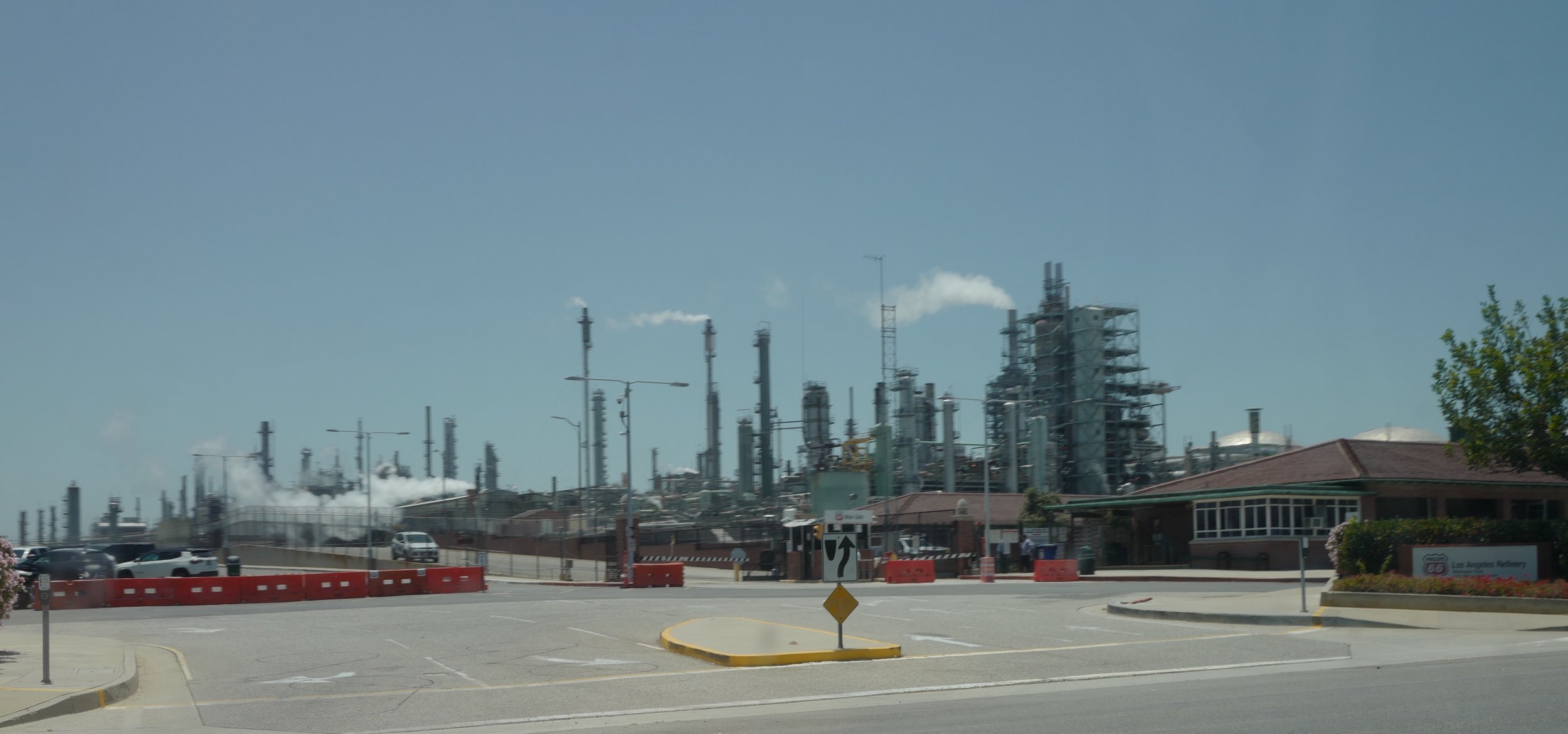
An oil refinery in Wilmington photographed in 2024 (copyright by the author)